Listen Now!
SpotifyApple
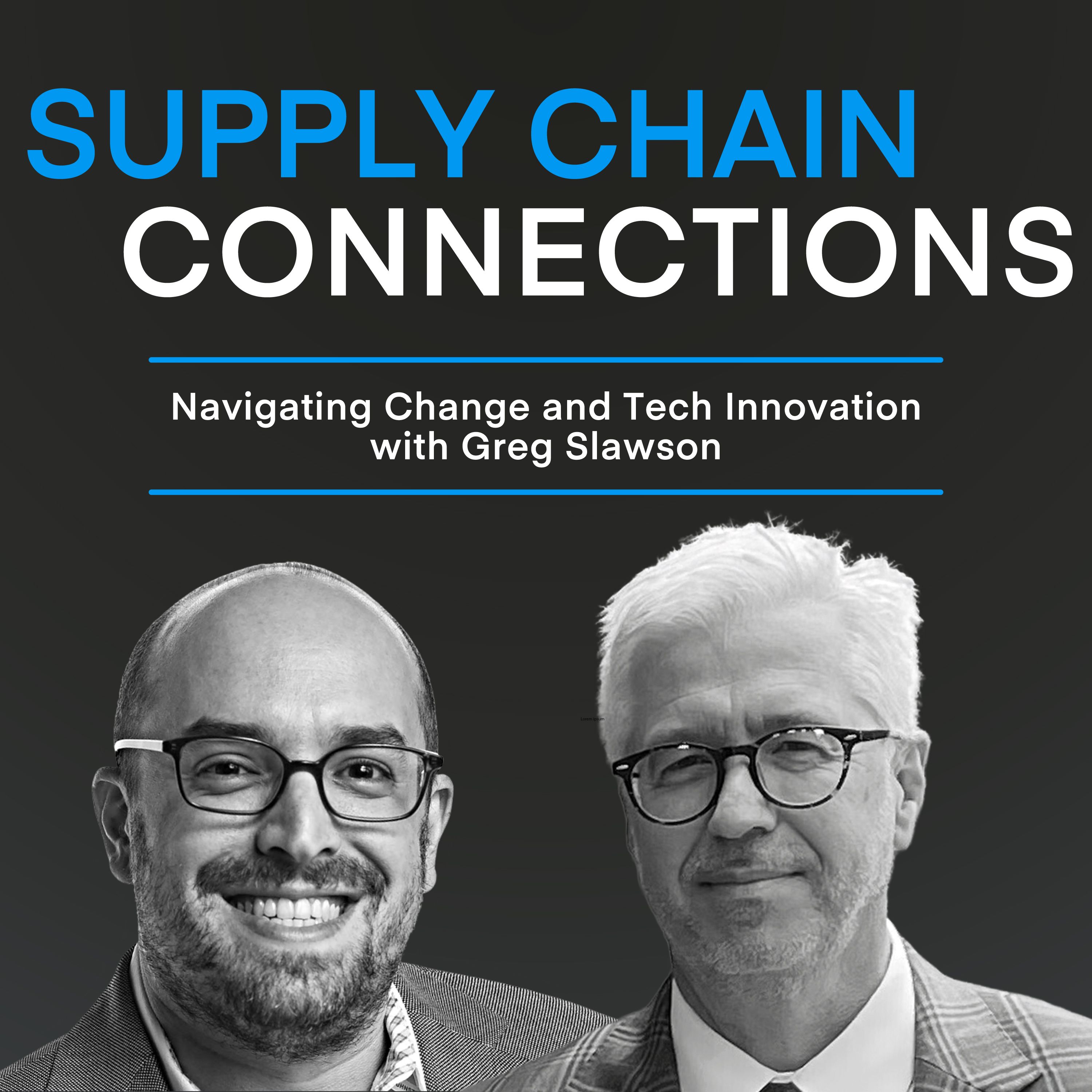
In this episode of Supply Chain Connections, Greg Slawson joins Brian Glick to share insights from a career spanning automotive manufacturing, global consulting, logistics tech startups, and leading freight forwarders. The conversation dives deep into how large organizations approach decision-making, how to handle cultural differences in global logistics, and what the future holds for technology in the industry.
What you’ll hear about:
- The evolution of Greg’s supply chain journey from Ford to Deloitte to DSV
- Lessons on navigating bureaucracy, change management, and cross-cultural communication
- The challenge of balancing customer needs with asset utilization in large carriers
- The emerging role of agentic AI and orchestration in reducing manual, low-value tasks
- Practical AI applications for 3PLs to boost efficiency and profitability
- Why real partnerships between shippers and service providers are rare—but powerful when they happen
- The ongoing shift toward more volatile, opportunity-rich global supply chains
Listen Now!
SpotifyAppleEpisode Transcript
[00:00:00] Brian Glick: Welcome to Supply Chain Connections. I'm Brian Glick, founder and CEO of Chain.io. On this episode, we're gonna chat with Greg Slawson. Greg has really seen all the angles of the industry and we're gonna have a really good time talking about working at very large companies, whether that's in automotive and consulting, the service provider side.
[00:00:23] And it's just gonna be a great conversation about navigating cultures and change management and technology and how that's all gonna change in the future. So hope you enjoy the episode.
[00:00:38] Brian Glick: Greg, welcome to the show.
[00:00:40] Greg Slawson:Thanks for having me. Looking forward to it.
[00:00:42] Brian Glick: So you've kind of been in all angles of this industry, but, if we go back to the beginning, how did you get into logistics and supply chain, and why did you decide to stick around?
[00:00:51] Greg Slawson: So Brian, I have a theory that nobody starts out looking to be in supply chain.
[00:00:56] It finds you. I was working for Ford motor company in manufacturing and I had an opportunity, I'd gone through some launches and things like that, and I had a couple promotional opportunities and one of those, one of my mentors suggested that that would be a quicker, easier pathway for a promotion
[00:01:15] than the other option I had, which is through more traditional manufacturing and engineering and things like that, and he was correct. There was a lot of low hanging fruit there, but I think what I found really exciting was that it was such a dynamic environment. Every day was a different challenge.
[00:01:32] Every day was a different opportunity to do something, to keep a plant running or to keep a customer happy. And I think that that excitement around supply chain is just, it gets in your blood, right? And that's kinda led to a number of different roles for me over the last three decades.
[00:01:51] Brian Glick: So take me through a little bit of, you know, there was Ford and then I see, maybe we'll have to explain to everyone else what G-Log was, uh, because they, so they know it under a different name.
[00:02:01] Greg Slawson: Now lemme kind of take you through the short story, right? I'm working at Ford. I'm getting to do some really interesting things. This is. Back in the mid nineties. Right? And Ford was building their own in-house ERP system. I had an opportunity to be one of the user experts on production scheduling and inventory management.
[00:02:20] So that's kinda my first taste at the technical side of supply chain and getting involved in technology and how technology could support business objectives and those kind of things. So really good experience. Rolled out of that, did a couple more senior level jobs. I had gotten to the point at Ford where
[00:02:36] I was considered an executive, which really means I was a mid-manager, right? It was gonna take a long time to move up. Right? And, you know, the paramedic gets pretty tight. I had a chance to go to Deloitte Consulting, which was a really great opportunity for me. Deloitte allowed me to build out my resume, learn more about how to communicate at a senior level, an executive level, uh, really good opportunity.
[00:02:59] I did a lot of global supply chain projects around the world, so kind of opened my eyes to what was going on outside of North America, outside of my little bubble, which at the time was pretty automotive centric. Had a unique opportunity to go to work for a company called G-Log, Global Logistics Technologies.
[00:03:17] G-Log was one of the early TMS platforms, you know, multi-mode currency, multi-user. We kind of competed against the I2s of the world and some of those kind of guys. I came in there to help build and run their automotive vertical and it was a really exciting time. Great team of people. You probably know a bunch of those guys.
[00:03:38] They were all based in the Philadelphia area, so really creative group. I was probably employee number 70 or 75 or something like that, the company, you know, so we already, you know, not early stage, but near early stage, right? We sold that company to Oracle in 2005, but it was a really great opportunity for me to even get, you know, deeper on the technical side and learn how to interact
[00:04:06] and bring customer requirements and work with our developers and work with our programmers to take a business requirement and turn that into a real solution that could work for them. So again, a really neat opportunity I think for somebody early in their career. And I think one of the really interesting things about supply chain is, you know, supply chain doesn't do a really good job in my mind of career pathing for people, right?
[00:04:30] And I think the people who really succeed in this space take the opportunities to do a lot of different things. So I had a lot of fun at G-Log. Kind of had the startup bug after that. Did a different startup completely outside of supply chain for six years, CEO of a clean tech company. Then had a chance to go back into supply chain on the logistics service provider side.
[00:04:54] So kind of a different space for me. I'd been on the shipper side. I've been on the technical side at a technology company, and now I'm on a pure play logistics service company, global freight forwarder. And I spent the last 15 years in the global freight forwarding business running $3.2 billion verticals for most recently DSV.
[00:05:16] Brian Glick: So I'm curious about something, I always like to ask this when somebody's sort of been on all these different sides of their relationships, you've actually done it at some very, very large companies, right? It's one of the largest in the world. Deloitte, one of the largest in the world. So when we think about
[00:05:33] decision making processes in large companies. I would imagine that even amongst those, like the decision making, processing consulting company versus an automotive manufacturer versus a 3PL, is it the same everywhere or is it different based on the different types of companies?
[00:05:51] Greg Slawson: I think it's different. I think the bigger you get, the more bureaucracy there is, regardless of what kind of company it is. I think there's some nuance around each of those, right, and, and different lessons learned. I mean, obviously when you work for, in my case, a big manufacturing company, supply chain isn't core business to them, right?
[00:06:11] It is a support function. So every decision that you make in supply chain is to support the bigger business enterprise and objectives, right? So it's a different perspective on supply chain. It's not a revenue generating function. And then at Deloitte you're really supporting customers, but it's a different relationship, right?
[00:06:32] In a lot of cases it's more of a partnership. And I think the things that I learned at Deloitte were absolutely incredible to me 'cause I learned a lot about how to deal with a customer not from the customer is always right, but I have an obligation to do what's best for the customer. And I think learning how to say no to a customer and learning how to provide them with a different perspective than they have is something that Deloitte was really great at helping me learn how to do, and that's a piece of the business that I think is so underrated. When I went to work as a logistics service provider,
[00:07:11] being able to sit in front of a client and help them. 'cause a lot of times, you know, when you think about a lot of these shippers, they rotate people through assignments. They don't necessarily always have supply chain expertise in the logistics roles and the transportation roles and things like that.
[00:07:29] It's a stop on their way somewhere else. And having the confidence to be able to sit across from clients and say, hey, you might wanna rethink this, right? Learning how to tell them no and essentially how to tell them they may want to think about or they're wrong in the way they're looking at something, or they could be wrong.
[00:07:45] I think that's something that I learned at Deloitte. During my tenure at DSV, DSV grew very quickly, through acquisitions. I think you are very familiar with DSV, and I'm sure a lot of our listeners will be, you know, DSV was not a huge company when they acquired UTI, where I was by the time I left, they were a huge company.
[00:08:04] So initially, DSV was very much an entrepreneurial company and decisions were made at the vertical level, at the division level, at the regional level, you didn't have to go through corporate for a lot of the decisions, right? It was a quick discussion that you made a decision and you took it, and if it was wrong, you fixed it and you moved on.
[00:08:26] I think for a lot of the right reasons, as they got bigger, part of the culture started to change, right? And decision making processes and strategies got more sophisticated. A little more cumbersome, but you've got a lot more stakeholders at that point in time than you did when it was a 20,000 person company.
[00:08:45] Brian Glick: So one of the things, I was actually talking about this yesterday at a conference that, if you look at companies that have a lot of capital assets, right? So Ford as an example. Your decision making processes kind of are influenced by the fact that I can't decide to build a plan and then not use it, right?
[00:09:05] Like that's a very bad idea versus, hey, we're gonna charter a couple of planes for a couple of runs out of Shanghai and if we can't fill 'em. The world will end. And we're gonna try to, we're gonna try to sell into that capacity a little bit. I'm curious what you think about the carriers who sort of now, you know, and Maersk being the stalking horse for this, but as they go into these non-asset things and they have that kind of capital intensive decision making process, do you think that affects their ability to be as agile as the pure non asset providers?
[00:09:40] Greg Slawson: Yes, I do. And it's hard to serve two masters, right? And to your point, you've got these massive asset investments and you've gotta figure out a way to utilize those. And you've gotta figure out a way to feed your own network. So there's a conflict there. UYou know, right, wrong, indifferent, where you know, are you gonna do the best every time for your customer?
[00:10:02] Are you gonna do the best for feeding your own network and protecting those assets and things like that. So I think that's a, you know, whether you're Maersk or CMA, CMG, or you know, these other guys that play on both sides of the field, it's a difficult process to be both an advocate for your client and an asset based provider.
[00:10:23] Brian Glick: So looking forward a little bit, kind of what's got you excited right now, right? You're in a new phase and what are you excited about?
[00:10:30] Greg Slawson: So I've been spending a lot of time talking to people like you and people around the industry. I think there's a lot of, I call 'em dirty jobs in supply chain and logistics.
[00:10:40] And what I mean is there are a lot of jobs out there that we do because they need to be done. It's a necessary evil, but they don't necessarily add value. And when I look at how fast AI is developing, particularly agentic AI and some of the capabilities around that, the ability to create solutions, I mean, one of the biggest problems, and you could probably talk about this all day in supply chain, has been interoperability, right?
[00:11:05] Between shippers, asset-based providers, non-asset based, 4PLs or forwarders or things like that. And I think agentic AI, some of the other tools out there create an opportunity to do things in supply chain that we've never experienced before. I think to me what gets me really excited is thinking about where those opportunities are and how you could deploy technology to remove people from non-value adding jobs.
[00:11:36] So you can either redeploy those people somewhere much more valuable in your supply chain or reduce your operating costs and create a much more efficient supply chain.
[00:11:46] Brian Glick: So I've been hearing a couple of different thought processes as I've been talking to people about this exact topic and there's sort of this school of thought of, we're gonna come in and use the AI to revolutionize or to rebuild the whole process or do this kind of massive layer orchestration of all the things.
[00:12:11] And then there's this other thought process, which is sort of the bottom up, which is, that's kind of what you just said, right? There's enough garbage going on that you just go pick off the low hanging fruit and there's the view there and I, I have an opinion, but before I share it, like do you think those things are in confluence with each other or do you think there's a right and wrong there?
[00:12:29] Greg Slawson: I'm not sure there's a right and a wrong Brian. My kind of underlying thesis is, I think orchestration is ultimately where this needs to go. I think when I think about some of these point solutions, I think of it like a digital temp agency, right? Where I'm not really solving the bigger problem. I'm not really making workflows better.
[00:12:50] I'm not creating more ROI and true labor efficiency. I'm just offsetting a function with maybe a very specific digital agent. So I'm a believer that as these tools develop and the models get smarter, you'll be able to have, you know, an orchestration engine on top of it, managing multiple agents to actually do complete workflows.
[00:13:18] And I think that's ultimately gonna be where the most value is created in supply chain.
[00:13:26] Brian Glick: So one of the things I've noticed, and certainly I even did it myself, was as I started learning about this stuff, I said, okay, I wanna solve this little thing. And then I went, oh, well if I wanna solve, kind of, you know, like in the case of like, the first thing I looked at was just like, are we doing, you know, are the, are, is the routing compliant to the SOP?
[00:13:44] Some simple question like that, right? And then as you do that, you go, oh, well if I could do that, I could also do this. And if I could do this and now I could do this, and the next thing you know you're rebuilding the whole business process and the whole thing. So I will tell you my opinion is that a lot of very smart people are gonna be too smart for their own good and they're gonna bite off more than they can chew.
[00:14:05] Instead of selling the thing, like the ones who are doing it well are gonna sell the first thing first and see whether they can get to the top of the mountain versus trying to build the whole mountain.
[00:14:16] Greg Slawson: I would agree with you. I think there's a lot that you have to learn to be able to provide that kind of agentic orchestration model.
[00:14:23] There's a lot you need to know before you can do that, and I think there's some trial and error that you want to do at a task level. I also think it's really important that I look at this more from a business standpoint, and I don't think about these solutions as a software as a service product as much as I think of them as a business product.
[00:14:45] Right, and I think that's where I probably differ from what I was at, say G-Log, where you're really selling TMS, you're selling software as a service or you know, on a license or things like that. I think these orchestrated solutions are not going necessarily to belong to a tech company, but are gonna belong to the operator.
[00:15:07] Now, most operators are nowhere near the ability to do these kind of things. So I think it's gonna be an interesting transition phase. I think it's gonna take not, you know, a couple years, but I think we're probably looking five years down the road before we're able to see consistently well constructed, orchestrated solutions that work with a high degree of fidelity.
[00:15:29] But I do think that's ultimately where the industry needs to go.
[00:15:35] Brian Glick: So when you say the operator there, are you envisioning that this is gonna be the cargo owner who's doing this for the like and everyone's gonna do it for themselves, or that it's the 4PLs who are gonna do it?
[00:15:46] Greg Slawson: I think the 3PLs have a big play in here.
[00:15:48] I do think at some point in time you're gonna see. An agent setting at a 3PL or a 4PL talking to an agent at a shipper, right? To do simple things like, you know, what time do I, what's my dock scheduling look like? Or things like that, right? You're still gonna have to have human in the loop because we work in an uncertain world and things happen, but I think the biggest win is going to be the logistics service providers.
[00:16:18] There are so many things that they do today that are manual, that are repetitive, that are low value, necessary evils, these kind of dirty jobs, right? And I think those kind of activities are gonna be the ones that are the low hanging fruit.
[00:16:34] Brian Glick: You and I are thinking it's exactly the same way. So I hope, I hope nobody's hoping to listen to a lot of controversy today.
[00:16:40] Greg Slawson: Well, if somebody disagrees, I hope they reach out to you, Brian. 'cause I'd love to, I think it's great to have these kind of debates though, about how these things end up shaking out.
[00:16:50] Brian Glick: Yeah. What I'd said in the last conference that I spoke at, I, you know, I was very focused on mid-market 3PLs. And so from an M & A perspective, I said, look, if you wanna boost your EBITDA,
[00:17:00] use the AI to get rid of, like make sure all of your RFPs are actually getting responded to and then make sure that you're not wasting all this time on paperwork. So like there's the 20% boost team in order to be able to set your company.
[00:17:14] Greg Slawson: I think you're exactly spot on. And I think if you look at our industry, there's pockets of those kind of things that are all over the place.
[00:17:20] Whether it's RFP response or think about just something as basic as dispatch. To me, you know, if you actually kind of do a time study on a typical. dispatch job, probably 70% of what they do could be done by an automated agent. Right? And, you know, calling for checking on something that happened. Did it happen?
[00:17:40] Did it not happen? Is my driver where he needs to be? Are the goods ready for pickup? Are they gonna be available when they're supposed to be? I mean, so you think about those kind of things, and you're right. If you're able to make a positive contribution to those things, you get EBITDA uplift on day one.
[00:17:56] Brian Glick: So I want to double back on something you mentioned earlier about kind of learning how to tell the customer that they're wrong. Right? And what I want to ask is specific to, you know, you've worked in companies that have been headquartered in different places in the world and with different cultures, and the way you tell someone that they're wrong can be very, very different.
[00:18:21] Kind of depending on culture. And actually, it's funny that you worked at Ford because the scene that always goes through my head is the one in Ford versus Ferrari where he's gotta confront Mr. Ford and tell him that all his VPs are full of crap and that he needs to just go to war with Mr. Ferrari.
[00:18:34] Right? And uh, like what have you learned about delivering that message to different, you know, shippers or different constituents throughout this very global industry?
[00:18:46] Greg Slawson: Yeah, that's a great question and you just have to be aware, right? I think one of the great things about my 15 years in global freight forwarding was being able to build relationships all over the world and work with people on, you know, six outta seven continents.
[00:19:00] And you're right, I mean, there's cultural nuance about how you say no and how you can disagree with people and it's part of the learning process, right? I mean, if I'm in Japan, it's a little different than if I'm sitting in front of somebody in Denmark where they expect to have a very open and direct conversation, right?
[00:19:20] So I think it's a learning process. I think that's one of the great things about our industry and what we do, and we get to travel the world and do these kind of things. I think though, at the end of the day, our job is to help our customers, right? Whether that's on the shipper side or the logistics service provide.
[00:19:35] And to do that with integrity, you have to learn how to disagree with people. And disagreement doesn't have to mean conflict. You know, it doesn't have to mean, you know, we're gonna go to war. But I've always believed that for me to do my job right, it's okay to walk into that space and feel like I can do that.
[00:19:53] And hopefully we both come out with a better outcome.
[00:19:57] Brian Glick: And I would argue that whether you're an LSP or a software vendor you actually have a responsibility to do that, and it's why you're getting paid in the first place, right? That the software vendors who just say yes to everything are not building a product.
[00:20:13] They're just glorified consulting shops and 3PLs that say yes to everything go out of business.
[00:20:18] Greg Slawson: They do. I think that's a very true statement. I mean, I remember my early days of software, you'd go into a customer and they would say, you know, I want whatever feature function, and typically, you know, the commercial team, the sales team may come back and say, we gotta build this.
[00:20:34] And we spent, and I'm sure a lot of software companies would spend a lot of time building a feature or a function that had absolutely no utility at the end of the day because somebody couldn't say no.
[00:20:48] Brian Glick: Yeah, I actually worked for a G-Log competitor in the same timeframe, and what probably made us less successful than a G-Log or GT Nexus was saying yes to our first customer, to the point where they broke our database model, right?
[00:21:03] Like it was so fine tuned to their supply chain. And I actually watched another company just before COVID who went out of business for effectively the same reason. They over-indexed on the feedback they got from their first customer and then they couldn't adapt the software to customer number two. So it's a very big wording and say for everybody who thinks they're building an AI agent and I'm just gonna go sit with the first customer for six months, you're about to build their internal AI agent.
[00:21:34] Greg Slawson:So one of my biggest complaints is, I think the most overused term is partnership between logistics service providers or tech providers and shippers and partnership. If you ask what partnership means to a big automotive OEM, and they're gonna say, give me the cheaper rates. And then, and then they're gonna turn around and they're gonna question you as a logistics service provider.
[00:21:58] And this is where it gets interesting, right? Because a lot of the shippers, I mean, let's face it, when you think about these companies, most companies, supply chain is not their core business, right? So they don't, supply chain doesn't get top dollar of budgets for investment in technology or whatever, right?
[00:22:18] They're further down the food chain. So when you go out and you talk to these clients, they want better technology. They all want better, you know, they want that trail of breadcrumbs or better event management or whatever. They expect that, but then they all want something different. I would always tell my client, I'm happy to invest in you, whether it was name the OEM.
[00:22:41] Right? I'm happy to make an investment in you, but not for a contract that's only 12 months.
[00:22:47] Brian Glick: And is it enforceable? Let's keep in mind.
[00:22:50] Greg Slawson: Well, exactly. So, I always laugh when people, you know, when customers would talk about partnership, right? 'cause it never benefits both parties or seldom does.
[00:23:00] Brian Glick: And when it does, it's amazing. But it is, it's exceedingly rare. You know, and I've had a few in my career where the knowledge of the BCO has made us so much better that it was worth us making the investment because they knew, and it you actually, one of the interesting index contracts, if I think back, almost all of the really great ones had executives who participated in industry advocacy groups or trade associations.
[00:23:30] Or did lobbying, and they were regularly talking to their peers and so they were able to understand what was them and what was, you know, also gonna be their competitor's problem and they would share that. They would say, you gotta do this for us, but build it this way so you can also use it for them.
[00:23:46] Greg Slawson: I probably spent a lot of time in the last couple years at DSV focused on helping procurement functions at my customer, understanding why traditional procurement may not be the best solution for you. Right. You know, buyers get measured by cost savings. Not necessarily by positive business outcomes. And trying to identify what the positive business outcome was and broadening that discussion
[00:24:15] so it's not just a service provider talking to procurement, but a service provider talking to procurement and operations and supply chain people to really lay out what it is that you want. When that happens, like you said, it's magic, right? You get all the people in a room, you're able to say, look, here's what we really need.
[00:24:33] This is what's gonna make this company stronger. It's not just a, you know, do you need to be cost competitive? Yes, but what does that really look like in an environment where my service provider is able to make investments in me, they're able to get value out of this, either through share of wallet growth or longer term agreements.
[00:24:52] That's a really difficult discussion to have, and I think you're right. The more the shippers of the world get out and engage with their colleagues and with the industry as a whole, those conversations become easier.
[00:25:07] Brian Glick: This might be a little bit of an ignorant question because I haven't done this in a very, very long time myself, but do you see a distinction or, or is there a distinction between like, I know some, some people I know who work in free procurement functions
[00:25:23] report into the supply chain organization directly versus, I'm assuming that there are others where they just are purely the person who got dropped in from the procurement organization. Is there a, like a difference in those relationships when can you map that? Like Yeah, like, does that make sense?
[00:25:41] Greg Slawson: Yeah. That there, there is, right? Yeah. I think when you work with people that are, I'm in procurement, but I'm a supply chain person, right? I've worked in this space, I've got knowledge of this space, I've got domain expertise. They understand what, you know, I mean, look, we've both worked in kind of the global freight forwarding space and we know how volatile that market is and things like that.
[00:26:01] I think when you're working with a buyer that's experienced in the modes that they buy and the products that they buy, it's a much different conversation. When you're working with somebody that's looking at everything like it's a commodity, whether it's ocean freight or a piece that goes on a car, you're gonna have a very different conversation and you're gonna spend a lot of time trying to educate those people.
[00:26:25] I think the other thing that makes it difficult for shippers is how they budget, right? And I've been on both sides and you, you create a budget and then there's volatility in the market and you've got these very strong financial guidelines that you don't want to deviate from. So how do you learn how to create flexibility in the way you build your budgets, the way you build your contracts, the way you engage with the outside industry?
[00:26:51] And those are not easy questions to solve
[00:26:54] Brian Glick: Outside AI and tech, what else do you think is cool that's going on in the industry? Like what else do you see out there?
[00:27:01] Greg Slawson: Well, I think it's a really exciting time just because to me volatility is opportunity. Right. And I think we live in a fairly volatile world right now.
[00:27:12] There's a lot going on, whether it's with terrorists or geopolitical posturing around the world, and you know, that creates opportunities. There's a lot of discussion around what supply chains should look like in the future. I mean, we spent basically 30 years getting more and more global. I don't care where you were in the world.
[00:27:31] Right? And now we're probably gonna spend some time, you know, rethinking that. Not that we're not going to be global. But I think global may look a little different, right? You're gonna have, you know, different strategies to build in more resilience and things like that. And I think those are really exciting times where you can take a look at supply chains, you can help customers design better supply chains, more robust supply chains.
[00:27:54] I think that's, I think those things are exciting to do. I think when you do the same thing every day, it gets a little boring.
[00:28:00] Brian Glick: I can tell it’s in your blood. Well, I mean, I'm the same way.
[00:28:05] Greg Slawson: So, yeah. And look, I think curiosity is what drives people like us, right? And I think having, and, and not that you have to know the answers, 'cause most of the time I don't.
[00:28:13] But I, I love to be part of that discussion about how do we solve these problems? And, and I think there's, you know, technology's never gonna be a panacea that just solves everything. Can it make things a lot better? Yes, it can. Can it change if I'm a logistics service provider, if I get my tech stack right, can it change my business outcome and make me a much more successful company?
[00:28:38] Absolutely. If I do it wrong, can it put me outta business? Absolutely. So, you know, I think that's important, but I think that there's a broader strategy about where I need to invest, how I need to think about, you know, what the markets are gonna look like in five years. You know, how do I compete? And where do I need to make my investments?
[00:28:58] Where do I need to place my bets?
[00:29:00] Brian Glick: So the big shots that I listen to speak on stages, right? The headliners at TPM and these people who do all the consulting with you and everything, they all, there seems to be a kind of a company line. The sort of, we had a multi-decade period of stability and that stability runs in cycles like the economy, but on much longer timescales.
[00:29:23] Do you kind of subscribe to the fact that we're now in a period where we should all be just thinking about, at least for you and I, the rest of our careers being in a period of instability? Or do you kind of think this is an aberration?
[00:29:37] Greg Slawson: I think it is a more volatile world. I don't know if it goes back to what it looked like maybe 15 years ago or whatever.
[00:29:47] I think there is more volatility, and I think part of that is we move quicker than we did. We have better information, we have better optics on what's going on in the world. So I think, yeah, I think it's gonna be more volatile. Do I think that has to be a bad thing? No, I don't. I think that's an opportunity.
[00:30:04] I mean, look, I think a lot of what we called stability wasn't necessarily because things were super efficient. It was just because we had built in, from a supply chain standpoint, at least we knew where our suppliers were located. We understood lead times really well unless there was something unique and we could build in buffers wherever we wanted them.
[00:30:24] That's changing a little bit now, right? You know, we don't have that same predictability, so I think we will be more volatile. I think that's gonna create more opportunities for us to do things differently. I think at the end of the day though, it doesn't necessarily equate to a less efficient supply chain.
[00:30:40] Brian Glick: Awesome. Well, I think that's a really good spot to wrap up, so again, appreciate you taking the time. Always great to hear people's views and thanks for coming on.
[00:30:49] Greg Slawson: No, it was a lot of fun. Thanks, Brian.
[00:30:56] Brian Glick: Thanks again to Greg for just an awesome conversation. I think that some of the insights around, especially how to talk to people and how to understand culture, and that we do have that responsibility to say no in a way that it's heard and that it's effective, it's just advice that everyone can take no matter what your role is in the industry.
[00:31:19] We'll have a link to Greg’s LinkedIn so you can follow him on his next set of exploits. And as always, make sure to check out Chain.io on LinkedIn and the blog and a lot of really new cool features we have coming out. We're particularly excited about some things we're doing to really help shippers eliminate a lot of manual work that you do.
[00:31:39] Reviewing and auditing the work and trying to be more proactive instead of reactive when it comes to understanding your freight as it's moving, instead of catching things once a problem has already happened. So keep an eye on our socials to learn more about that. And as always, I'm Brian Glick and look forward to speaking with you next time.